Af: Peter Larsen
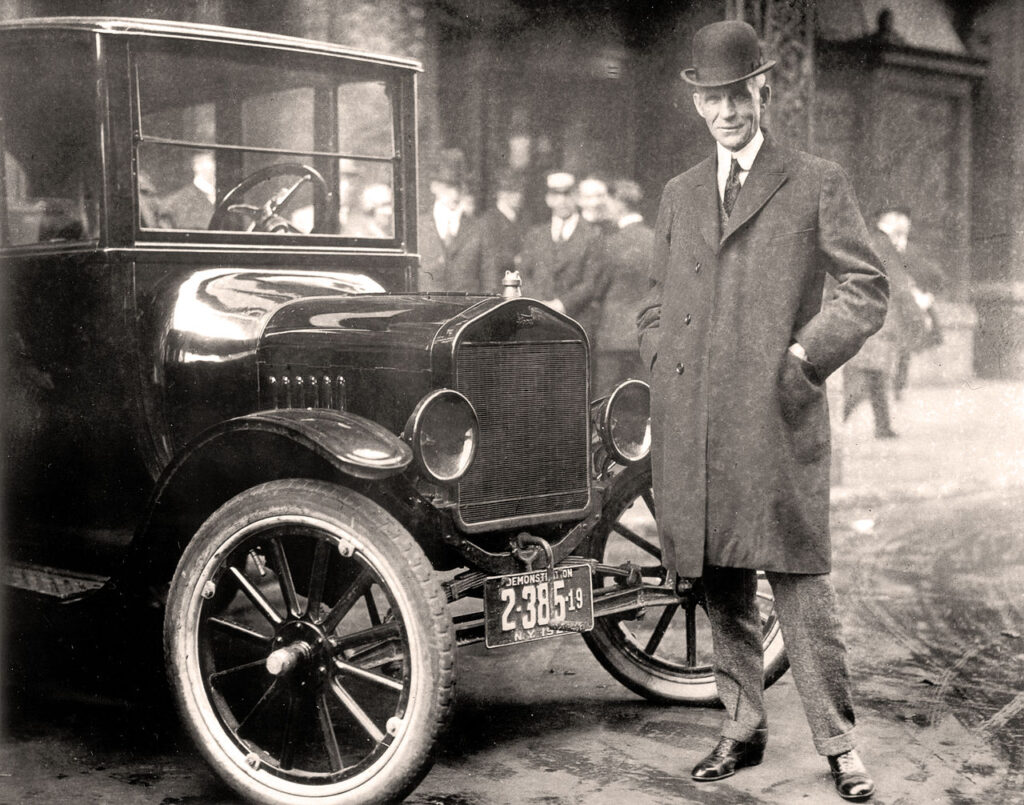
Henry Ford (1863-1947) var søn af en landmand, og han voksede op på en farm i Springwells Township (nu Dearborn), tæt på Detroit i staten Michigan. Han var ikke synderligt interesseret i landbrugsarbejde, han var mere interesseret i mekanik. Da han var tolv år så han for første gang et selvkørende lokomobil (en dampmaskine på hjul til at drive landbrugsmaskiner som fx tærskeværk), og det var med til at udvikle en idé hos ham om at flytte det hårde arbejde fra muskler til motorer.
Da han var sytten kom han i lære som maskinarbejder, og efter læretiden fik han arbejde med at reparere lokomobiler. De var tunge og dyre, så den almindelige farmer ville aldrig få råd til den slags, så han forsøgte sig med at konstruere en lille dampmaskine, der blev bygget på en vogn. Det lykkedes, den kørte fint og var nem at kontrollere, men han var ikke så vild med at sidde oven på en højtrykskedel. Han eksperimenterede med forskellige kedler et par år – men fandt så ud af at hvis kedlen skulle gøres sikker, ville den blive alt for tung, så han gik bort fra idéen – og skulle finde en anden type motor.
I 1885 fik han så mulighed for at reparere en otto-motor, hvor han fandt ud af hvordan en fire-takts benzinmotor fungerede, og i 1887 byggede han selv en lille motor. I 1890 byggede han en to-cylindret motor, og i 1892 byggede han sin første bil, Ford Quadricycle. Han kørte omkring 1000 miles i bilen inden han solgte den i 1896 – hans første salg. Så begyndte han på bil nummer 2:
It was not at all my idea to make cars in any such petty fashion. I was looking ahead to production, but before that could come I had to have something to produce. It does not pay to hurry. I started a second car in 1896; it was much like the first but a little lighter.
I 1899 startede Ford sammen med en gruppe finansfolk Detroit Automobile Company, hvor han i de næste tre år byggede biler med udgangspunkt i de to første. Der blev solgt omkring 20 biler, men partnerne havde ingen interesse i at udvikle bilen, så Ford forlod firmaet i 1902, fast besluttet på ikke at lade andre bestemme over ham.
Bilen var efterhånden blevet udviklet fra at skulle bevise at den overhovedet kunne køre til at den skulle kunne køre hurtigt, så Ford byggede i 1903 to racerbiler, ”999” og ”Arrow”, med en fire-cylindret motor på 80 hk. Ret vildt for den tid. Bilerne kørte stærkt (søg på nettet) og gav god reklame, så ugen efter det første løb startede han Ford Motor Company.
Ford begyndte med Model A 1903, og det første år solgte virksomheden 1708 biler. Året efter (1904) kom Model B, Model C og Model F. Der blev solgt 1695 biler. I 1905-6 1599 biler. Virksomheden eksperimenterede med både små og store biler med modellerne K(1906-8), N(1906-8), R(1907) og S(1907), og der var uenighed blandt ejerne om man skulle lave mange små biler med en lille fortjeneste pr. bil eller færre store biler med større fortjeneste pr. bil. Ford udtalte:
A car should not have any more cylinders than a cow has teats
han ville bygge en relativt simple bil til masserne.
The way to make automobiles is to make one automobile just like another automobile, to make them all alike – just as one pin is like another pin when it comes from the pin factory.
Ford’s vision var:
I will build a motor car for the great multitude. It will be large enough for the family but small enough for the individual to run and care for. It will be constructed of the best materials, by the best men to be hired, after the simplest designs that modern engineering can devise. But it will be so low in price that no man making a good salary will be unable to own one – and enjoy with his family the blessing of hours of pleasure in God’s great open spaces.
Ford overtog aktiemajoriteten og sænkede priserne, og solgte i 1906-7 8423 biler.
I 1909 var Ford klar med Model T, der levede op til hans ønsker om en relativt simpel og økonomisk bil. Han fokuserede så på produktionen.
I en artikel i leksikonnet Encyclopedia Britannica fra 1926 forklarer Ford hvordan hans idéer om produktion adskiller sig fra andres i et opslag om Mass Production:
It cannot be said, however, that the efficiency experts did more than direct attention to the problem, by showing, in selected instances, how the current methods were wasteful of men’s earning power, and how their correction and improvement could lead to greater production, hence higher wages, and therefore a general betterment of labour relations. They emphasised a more intelligent management of methods than was then in use; they did not see that a wholly new method was possible which would simply abolish the problems of which the old method, under the most intelligent management, was inevitably prolific. For example they dealt with methods which enabled labourers whose task was to load 12½ tons of pig-iron a day, to load 47½ long tons a day for an increase in the day’s pay from 1.15 to1.85. They did not see that another and better method might be devised which would make it unnecessary for a working-man to carry 106,400 lb. of pig-iron to earn $1.85.
Opslaget kan findes her: http://memory.loc.gov/cgi-bin/query/h?ammem/coolbib:@field(NUMBER+@band(amrlg+lg48))
Hvad gik Fords metode ud på?
I 1922 udkom Henry Fords fortælling om udviklingen af virksomheden Ford Motor Company og hans Ford Model T, ‘My Life and Work’ (kan findes her: https://en.wikisource.org/wiki/My_Life_and_Work)
Nedenstående er udvalgte klip fra bogen.
Ford om produktionsprincipper
In the beginning we tried to get machinists. As the necessity for production increased it became apparent not only that enough machinists were not to be had, but also that skilled men were not necessary in production, and out of this grew a principle that I later went to present in full..
I have heard it said, in fact I believe it is quite a current thought, that we have taken skill out of work. We have not. We have put in skill. We have put a higher skill into planning, management, and tool building, and the results of that skill are enjoyed by the man who is not skilled..
The more economical methods of production did not begin all at once. They began gradually – just as we began gradually to make our own parts.. The great economies began in assembling and then extended to other sections so that, while to-day we have skilled mechanics in plenty, they do not produce automobiles – they make it easy for others to produce them. Our skilled men are the tool makers, the experimental workmen, the machinists, and the pattern makers.. The rank and file of men come to us unskilled; they learn their jobs within a few hours or a few days..
A Ford car contains about five thousand parts – that is counting screws, nuts and all.
The first step forward in assembly came when we began taking the work to the man instead of taking the man to the work.
Along april1, 1913, we tried the experiment of an assembly line. We tried it on assembling the flywheel magneto. We try everything in a little way first – we will rip out anything once we discover a better way, but we have to know absolutely that the new way is going to be better than the old befor we do anything drastic. I believ that this was the first moving line ever installed. The idea came in a general way from the overhead trolley that the Chicago packers used in dressing beef. We had previously assembled the fly-wheel magneto in the usual method. With one workman doing a complete job he could turn out from thirty-five to forty pieces in a nine-hour day, or about twenty minutes to an assembly. What he did alone was then spread into twenty-nine operations; that cut down the assembly to thirteen minutes, ten seconds. The we raised the height of the line 8 inches – this was in 1914 – and cut the time to seven minutes. Further experimenting with the speed that the work should move at cut the time down to five minutes. In short, the result is this: by the aid of scientific study one man is now able to do somewhat more than four did only a comparatively few years ago.
The assembling of the motor, formerly done by one man, is divided into eighty-four operations – those men do the work that three times their number formerly did. In a short time we tried out the plan on the chassis..
The man who puts in a bolt does not put on the nut; the man who puts on the nut does not tighten it.
If a machine can be made automatic, it is made automatic. Not a single operation is ever considered done in the best or cheapest way. At that, only about ten per cent. Of our tools are special; the others are regular machines adjusted to the particular job. And they are placed almost side by side.
Hvilke problemer skriver Ford om her?
Hvad var løsningen?
Ford om lønninger
No question is more important than that of wages – most people in the country live on wages. The scale of their living – the rate of their wages – determines the prosperity of the country.
It took us some time to get our bearings on wages,.. the wages were not scientifically adjusted to the jobs.. Therefore, starting about 1913 we had time studies made of all the thousands of operations in the shops. By a time study it is possible theoretically to determine what a man’s output should be.. Without scientific study the employer does not know why he is paying a wage and the worker does not know why he is getting it.. Having these facts in hand we announced and put into operation in January, 1914, a kind of profit-sharing plan in which the minimum wage for any class of work and under certain conditions was five dollars a day. At the same time we reduced the working day to eight hours – it had been nine – and the week to forty-eight hours.
The large wage had other results. In 1914, when the first plan went into effect, we had 14,000 employees and it had been necessary to hire at the rate of about 53,000 a year in order to keep a constant force of 14,000. In 1915 we had to hire only 6,508 men and the majority of these new men were taken on because of the growth of the business. With the old turnover of labour and our present force we should hire at the rate of nearly 200,000 men a year – which would be pretty near an impossible proposition.
Instead of giving attention to competitors or to demand, our prices are based on an estimate of what the largest possible number of people will want to pay, or can pay, for what we have to sell. And what has resulted from that policy is best evidenced by comparing the price of the touring car and the production:
| Year | Price | Production |
| 1909-10 | $950 | 18,664 cars |
| 1910-11 | $780 | 34,528 “ |
| 1911-12 | $690 | 78,440 “ |
| 1912-13 | $600 | 168,220 “ |
| 1913-14 | $550 | 248,307 “ |
| 1914-15 | $490 | 308,213 “ |
| 1915-16 | $440 | 533,921 “ |
| 1916-17 | $360 | 785,432 “ |
| 1917-18 | $450 | 706,584 “ |
| 1918-19 | $525 | 533,706 “ |
| (The above two years were war years and the factory was in war work). | ||
| 1919-20 | $575 to $440 | 996,660 “ |
| 1920-21 | $440 to $355 | 1,250,000 “ |
In the first place, I hold that it is better to sell a large number of cars at a reasonably small margin than to sell fewer cars at a large margin of profit. I hold this because it enables a large number of people to buy and enjoy the use of a car and because it gives a larger number of men employment at good wages. Those are aims I have in life. But I would not be counted a success; I would be, in fact, a flat failure if I could not accomplish that and at the same time make a fair amount of profit for myself and the men associated with me in business.
Hvilke problemer skriver Ford om her?
Og hvad var hans løsninger?
Ford om fremtidens produktion
The most economical manufacturing of the future will be that in which the whole of an article is not made under one roof.. The modern – or better, the future – method is to have each part made where it may best be made and then assemble the parts into a complete unit at the points of consumption.. it would make no difference whether one company or one individual owned all the factories fabricating the component parts of a single product, or whether such part were made in our independently owned factory, if only all adopted the same service methods. If we can buy as good a part as we can make ourselves and supply is ample and the price right, we do not attempt to make it ourselves.
Hvordan så Ford på fremtidens produktion? Så han rigtigt?
Ford om markedet
Ask a hundred people how they want a particular article made. About eighty will not know; they will leave it to you. Fifteen will think that they must say something, while five will really have preferences and reasons. The ninety-five, made up of those who do not know and admit it and the fifteen who do not know but do not admit it, constitute the real market for any product. The five who want something special may or may not be able to pay the price for special work.
If I had asked people what they wanted, they would have said faster horses.
Hvilket syn havde Ford på markedet? Hvad mener du?
Her kan du finde en instruktionsbog til Ford Model T: https://archive.org/details/1919_Ford_Model-T_Manual/mode/2up