Af: Peter Larsen
Adam Smith (1723-1790) Billede hentet fra: commons.wikimedia.org/wiki/File:AdamSmith.jpg
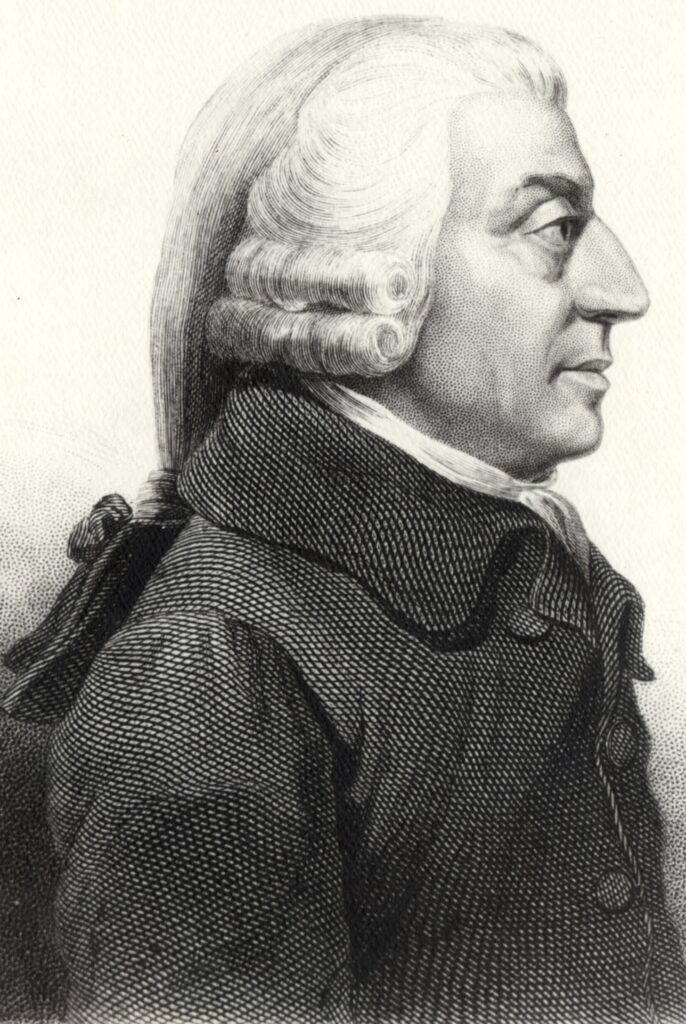
Adam Smith var en britisk økonom, født i Skotland. Han er kendt som liberalismens fader.
I sin bog ’An Inquiry into the Nature and Causes of the Wealth of Nations’ fra 1776 går Adam Smith til angreb på merkantilismens idé om at øge eksporten af varer og mindske importen af varer, hvor man giver støtte til eksport og lægger told på import.
At give støtte til eksport er ifølge Adam Smith meningsløst, skal næste skridt være at betale folk for at købe?
Og at lægge told på import vil nok styrke hjemmeindustrien, men også mindske konkurrencen og i sidste ende føre til monopoler og højere priser.
Et land skal købe varer, der kan produceres billigere i andre lande, og betale med varer, landet selv kan producere billigere.
Adam Smith mente at økonomisk vækst afhænger af specialisering og arbejdsdeling – specialisering og arbejdsdeling giver højere produktivitet, forstået som større produktion med de samme ressourcer. Graden af arbejdsdeling hænger sammen med markedets størrelse – en lille by har få specialbutikker, mens en stor by har mange – så handel mellem lande gør markedet større, giver mulighed for mere specialisering og dermed en international arbejdsdeling og deraf følgende højere produktivitet – til glæde for alle lande.
Adam Smith så markedskræfterne som selvregulerende – som styret af en ’usynlig hånd’. Handler man I strid med markedets interesser og ønsker bliver man automatisk straffet økonomisk.
Her følger nogle eksempler på hvad Adam Smith skrev om at dyrke vin i Skotland, om erhvervsstøtte og toldsatser, om arbejdsdeling og om teknologiudvikling. Til sidst et opslag fra Encyclopædien, der illustrerer hans eksempel fra et knappenålsmanufaktur.
Adam Smith om at fremstille vin i Skotland
By means of glasses, hotbeds, and hot walls, very good grapes can be raised in Scotland, and very good wine too can be made of them at about thirty times the expence for which at least equally good can be brought from foreign countries. Would it be a reasonable law to prohibit the importation of all foreign wines merely to encourage the making of claret and burgundy in Scotland?
Hvilket problem skriver Adam Smith om her? Og hvad er, i følge Adam Smith, løsningen?
Adam Smith om erhvervsstøtte og toldsatser
To give the monopoly of the home-market to the produce of domestic industry, in any particular art or manufacture, is in some measure to direct private people in what manner they ought to employ their capitals… It is the maxim of every prudent master of a family never to attempt to make at home what it will cost him more to make than to buy. The taylor does not attempt to make his own shoes, but buys them of the shoemaker. The shoemaker does not attempt to make his own clothes.. All of them find it for their interest to employ their whole industry in a way in which they have some advantage over their neighbours, and to purchase.. whatever else they have occasion for.
What is prudence in the conduct of every private family can scarce be folly in that of a great kingdom. If a foreign country can supply us with a commodity cheaper than we ourselves can make it, better buy it of them with some part of the produce of our own industry employed in a way in which we have some advantage.
Hvilket problem taler Adam Smith om her? Og hvad er, i følge Adam Smith, løsningen?
Adam Smith om arbejdsdeling
The greatest improvement in the productive powers of labour, and the greater part of the skill, dexterity, and judgment with which it is any where directed, or applied, seem to have been the effects of the division of labour.
To take an example, therefore, from a very trifling manufacture; but one in which the division of labour has been very often taken notice of, the trade of the pin-maker; a workman not educated to this business (which the division of labour has rendered a distinct trade), nor acquainted with the use of the machinery employed in it (to the invention of which the same division of labour has probably given occasion), could scarce, perhaps, with his utmost industry, make one pin in a day, and certainly could not make twenty.
But in the way in which this business is now carried on, not only the whole work is a peculiar trade, but it is divided into a number of branches, of which the greater part are likewise peculiar trades.
One man draws out the wire, another straights it, a third cuts it, a fourth points it, a fifth grinds it at the top for receiving the head; to make the head requires two or three distinct operations; to put it on, is a peculiar business, to whiten the pins is another; it is even a trade by itself to put them into the paper; and the important business of making a pin is, in this manner, divided into about eighteen distinct operations, which, in some manufactories, are all performed by distinct hands, though in others the same man will sometimes perform two or three of them.
I have seen a small manufactory of this kind where ten men only were employed, and where some of them consequently performed two or three distinct operations. But though they were very poor, and therefore but indifferently accommodated with the necessary machinery, they could, when they exerted themselves, make among them about twelve pounds of pins in a day.
There are in a pound upwards of four thousand pins of a middling size. Those ten persons, therefore, could make among them upwards of forty-eight thousand pins in a day. Each person, therefore, making a tenth part of forty-eight thousand pins, might be considered as making four thousand eight hundred pins in a day.
But if they had all wrought separately and independently, and without any of them having been educated to this peculiar business, they certainly could not each of them have made twenty, perhaps not one pin in a day; that is, certainly, not the two hundred and fortieth, perhaps not the four thousand eight hundredth part of what they are at present capable of performing, in consequence of a proper division and combination of their different operations.
In every other art and manufacture, the effects of the division of labour are similar to what they are in this very trifling one; though, in many of them, the labour can neither be so much subdivided, nor reduced to so great a simplicity of operation. The division of labour, however, so far as it can be introduced, occasions, in every art, a proportionable increase of the productive powers of labour.
Hvilket problem skriver Adam Smith om her? Og hvad er, i følge Adam Smith, løsningen?
Adam Smith om teknologiudvikling
A great part of the machines made use of in those manufactures in which labour is most subdivided, were originally the inventions of common workmen, who, being each of them employed in some very simple operation, naturally turned their thoughts towards finding out easier and readier methods of performing it. Whoever has been much accustomed to visit such manufactures, must frequently have been shewn very pretty machines, which were the inventions of such workmen, in order to facilitate and quicken their own particular part of the work.
In the first fire-engines, a boy was constantly employed to open and shut alternately the communication between the boiler and the cylinder, according as the piston either ascended or descended. One of those boys, who loved to play with his companions, observed that, by tying a string from the handle of the valve which opened this communication, to another part of the machine, the valve would open and shut without his assistance, and leave him at liberty to divert himself with his play-fellows. One of the greatest improvements that has been made upon this machine, since it was first invented, was in this manner the discovery of a boy who wanted to save his own labour.’
Hvordan foregår teknologiudvikling ifølge Adam Smith? Hvad driver teknologiudviklingen?
Lav en opsamling på klassen – hvilke problemer skriver Adam Smith om, og hvilke løsninger foreslår han? Hvordan så samfundet ud i England omkring 1776?
Alle citater er fra ‘The Wealth of Nations’, som du kan finde her: www.econlib.org/library/Smith/smWN.html
Et knappenålsmanufaktur – fra Encyclopædien
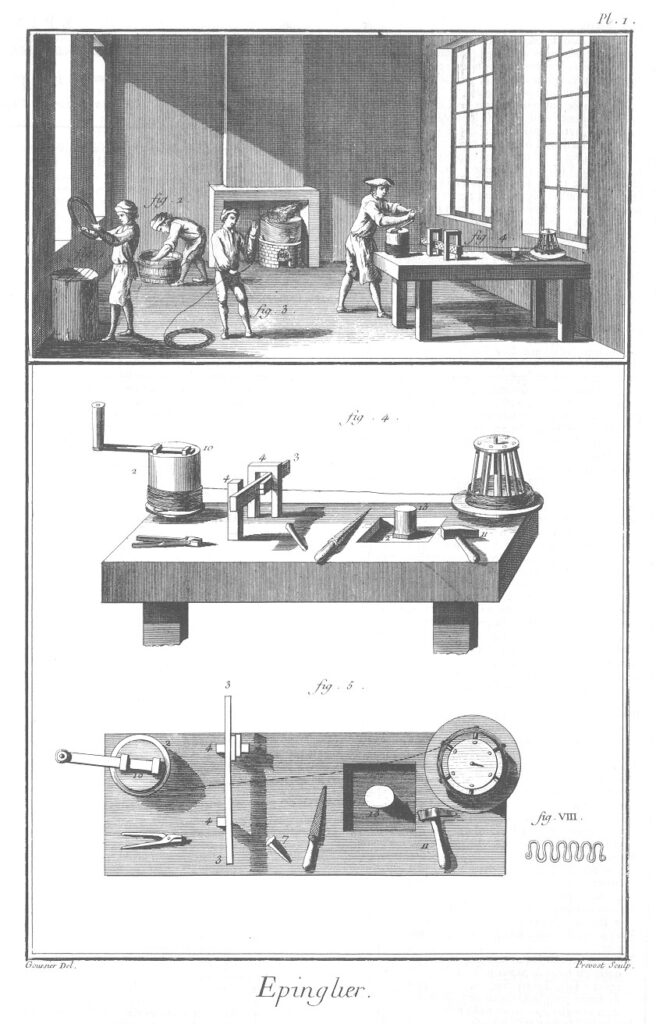
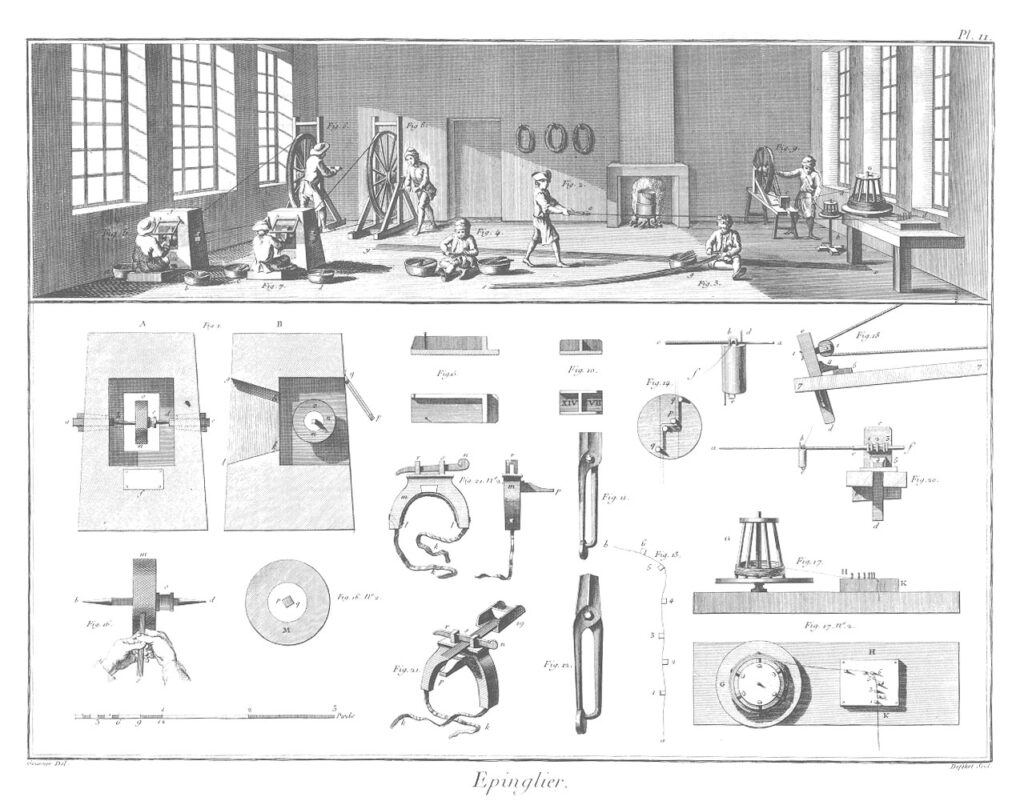
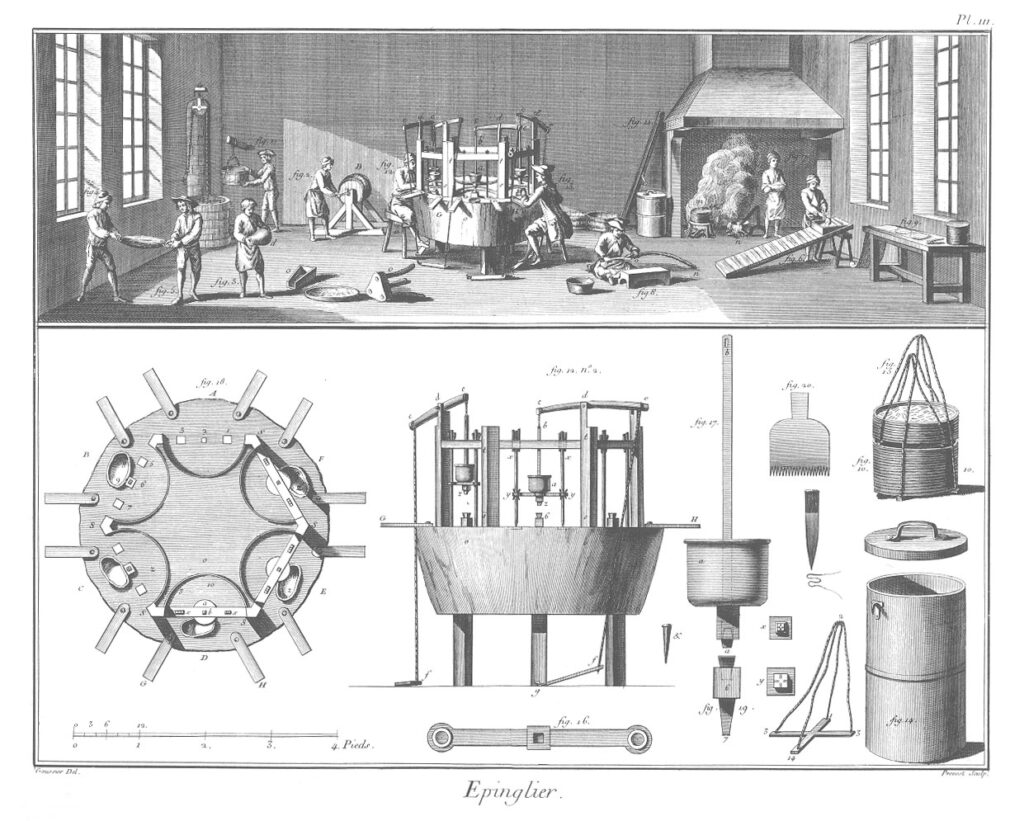
Kan I forklare hvordan maskiner og værktøj virker? Hvilke processer er blevet mekaniseret? Hvilke processer er blevet automatiseret? Hvilke er ikke?