Af: Peter Larsen
Billede af F.W. Taylor – hentet fra https://commons.wikimedia.org/wiki/File:Frederick_Winslow_Taylor.JPG
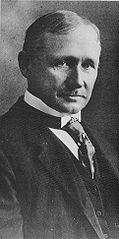
Frederick Winslow Taylor (1856-1915) kom fra en velstillet familie i Pennsylvania. Han fik en god grunduddannelse og begyndte at studere jura ved Harvard.
Her fandt han så ud af at han hellere ville arbejde med sine hænder, stoppede på Harvard og kom i lære som modelsnedker og maskinarbejder på en pumpefabrik.
Da han var færdig med læretiden fik han i 1878 arbejde som drejer hos Midvale Steel Works, hvor man brugte videnskabelige metoder til at forbedre stålkvaliteten og til at forbedre vinkler og former på skærende værktøjer.
Taylor var dygtig og havde gode forbindelser, så han steg hurtigt i graderne, og efter at have taget en ingeniøruddannelse pr. korrespondance (post) blev han i 1884 chefingeniør.
I 1881 begyndte han at udvikle grundlaget for en videnskabelig tilgang til arbejdsledelse (task management). Han havde en god forståelse af det stykke arbejde han studerede.
Første skridt er at opdele arbejdet i enkelte operationer, og måle hvor lang tid operationen tager.
I næste skridt ser man bort fra unødvendige deloperationer og man fokuserer på det rent teknologiske, og finder et optimalt tidsforbrug til den enkelte operation.
Så lægger man tid til uforudsete problemer til det optimale tidsforbrug, og til sidst lægges tid til hvile og pauser ind, og der tages hensyn til arbejderens arbejdsevne. Taylor fik på den måde en standard for arbejdet.
Selvom han mente at hans metode var til fordel for både arbejdsgivere og arbejdstagere – produktiviteten steg og arbejderen fik mere i løn – var det ikke nemt at få det gennemført. Der var et indarbejdet modsætningsforhold, som det var meget svært at ændre – for begge sider.
Taylor forlod Midvale i 1890, og efter en ansættelse hos Manufacturing Investment Company der havde papirfabrikker, hvor han blev træt af finansfolk, prøvede han i 1893 lykken som verdens første rådgivende ingeniør. Det gik strålende, der var brug for hans service, og efter nogle år havde han samlet en mindre formue. Samtidig arbejdede han videre med ’Scientific Management’ og udgav flere artikler om emnet.
Han arbejdede med at øge produktiviteten med Scientific Management på så forskellige områder som drejearbejde, kontorarbejde, inspektion af kuglelejer på en cykelfabrik og losning af råjern – og i 1901 fik han patent på high-speed stål til drejearbejde, efter en videnskabelig-empirisk proces, hvor han systematisk foretog eksperimenter med forskellige stållegeringer og hærdeprocesser.
Senere er der bygget videre på Taylor’s idéer, fx skærehastigheder for high-speed stål, hans assistent Henry Gantt udviklede en mere samarbejdsorienteret version af scientific management og fandt på gantt-kortet der stadig anvendes i projektplanlægning, der blev udviklet bevægelsesstudier og tidsstudier – og en række forskellige studier af arbejderes adfærd for at øge produktiviteten, hvor man fx fandt ud af at det øgede produktiviteten at øge belysningen – og at det øgede produktiviteten at sænke belysningen. Det øgede produktiviteten at forkorte arbejdstiden – og det øgede produktiviteten at forlænge arbejdstiden.
Selvom Taylors metode lægger vægt på samarbejde mellem ledelse og arbejdere har hans navn fået en negativ klang i begrebet taylorisering, hvor der er fokus på rationalisering og mennesket behandles som en maskine og styres af tidsstudier og arbejdsdeling.
I 1911 udkom bogen ‘The Principles of Scientific Management‘, hvor Taylor skriver om sine idéer. Bogen kan findes her: https://archive.org/details/principlesofscie00taylrich/mode/2up?view=theater
Nedenstående er udvalgte klip fra bogen.
Taylor om produktivitet
In the case of a more complicated manufacturing establishment… the greatest prosperity can exist only as the result of the greatest possible productivity of the men and machines of the establishment—that is, when each man and each machine are turning out the largest possible output; because unless your men and your machines are daily turning out more work than others around you, it is clear that competition will prevent your paying higher wages to your workmen than are paid to those of your competitor. And what is true as to the possibility of paying high wages in the case of two companies competing close beside one another is also true as to whole districts of the country and even as to nations which are in competition. In a word, that maximum prosperity can exist only as the result of maximum productivity.
The greatest material gain which those of the present generation have over past generations has come from the fact that the average man in this generation, with a given expenditure of effort, is producing two times, three times, even four times as much of those things that are of use to man as it was possible for the average man in the past to produce. This increase in the productivity of human effort is, of course, due to many causes, besides the increase in the personal dexterity of the man. It is due to the discovery of steam and electricity, to the introduction of machinery, to inventions, great and small, and to the progress in science and education. But from whatever cause this increase in productivity has come, it is to the greater productivity of each individual that the whole country owes its greater prosperity.
Hvorfor skriver Taylor om produktivitet?
Taylor om fabriksarbejde
The English and American peoples are the greatest sportsmen in the world. Whenever an American workman plays baseball, or an English workman plays cricket, it is safe to say that he strains every nerve to secure victory for his side. He does his very best to make the largest possible number of runs. The universal sentiment is so strong that any man who fails to give out all there is in him in sport is branded as a ‘quitter’, and treated with contempt by those who are around him.
When the same workman returns to work on the following day, in stead of using every effort to turn out the largest possible amount of work, in a majority of the cases this man deliberately plans to do as little as he safely can – to turn out far less work than he is well able to do – in many instances to do not more than one-third to one-half of a proper day’s work. And in fact if he were to do his best to turn out his largest possible day’s work, he would be abused by his fellow workers for so doing, even more than if he had proved himself a ‘quitter’ in sport. Underworking, that is, deliberately working slowly so as to avoid doing a full day’s work, ‘soldiering’, as it is called in this country.. is almost universal in industrial establishments, and prevails also to a large extent in the building trades; and the writer asserts without fear of contradiction that this constitutes the greatest evil with which the working-people of both England and America are now afflicted.
There are three causes for this condition, which may be briefly summarized as:
First. The fallacy, which has from time immemorial been almost universal among workmen, that a material increase in the output of each man or each machine in the trade would result in the end in throwing a large number of men out of work.
Second. The defective systems of management which are in common use, and which make it necessary for each workman to soldier, or work slowly, in order that he may protect his own best interests.
Third. The inefficient rule-of-thumb methods, which are still almost universal in all trades, and in practicing which our workmen waste a large part of their effort.
In an industrial establishment which employs say from 500 to 1000 workmen, there will be found in many cases at least twenty to thirty different trades. The workmen in each of these trades have had their knowledge handed down to them by word of mouth, through the many years in which their trade has been developed from the primitive condition, in which our far-distant ancestors each one practiced the rudiments of many different trades, to the present state of great and growing subdivision of labor, in which each man specializes upon some comparatively small class of work.
Hvad er det for et problem, Taylor skriver om her?
Hvad er årsagerne til problemet?
Taylor om metoden i Scientific Management
Under scientific management the “initiative” of the workmen (that is, their hard work, their good-will, and their ingenuity) is obtained with absolute uniformity and to a greater extent than is possible under the old system; and in addition to this improvement on the part of the men, the managers assume new burdens, new duties, and responsibilities never dreamed of in the past. The managers assume, for instance, the burden of gathering together all of the traditional knowledge which in the past has been possessed by the workmen and then of classifying, tabulating, and reducing this knowledge to rules, laws, and formulae which are immensely helpful to the workmen in doing their daily work. In addition to developing a science in this way, the management take on three other types of duties which involve new and heavy burdens for themselves. These new duties are grouped under four heads: First. They develop a science for each element of a man’s work, which replaces the old rule-of-thumb method. Second. They scientifically select and then train, teach, and develop the workman, whereas in the past he chose his own work and trained himself as best he could. Third. They heartily cooperate with the men so as to insure all of the work being done in accordance with the principles of the science which has been developed. Fourth. There is an almost equal division of the work and the responsibility between the management and the workmen. The management take over all work for which they are better fitted than the workmen, while in the past almost all of the work and the greater part of the responsibility were thrown upon the men. It is this combination of the initiative of the workmen, coupled with the new types of work done by the management, that makes scientific management so much more efficient than the old plan.
The general steps to be taken in developing a simple law of this class are as follows: First. Find, say, 10 or 15 different men (preferably in as many separate establishments and different parts of the country) who are especially skilful in doing the particular work to be analyzed.
Second. Study the exact series of elementary operations or motions which each of these men uses in doing the work which is being investigated, as well as the implements each man uses.
Third. Study with a stop-watch the time required to make each of these elementary movements and then select the quickest way of doing each element of the work.
Fourth. Eliminate all false movements, slow movements, and useless movements.
Fifth. After doing away with all unnecessary movements, collect into one series the quickest and best movements as well as the best implements.
This one new method, involving that series of motions which can be made quickest and best, is then substituted in place of the ten or fifteen inferior series which were formerly in use. This best method becomes standard, and remains standard, to be taught first to the teachers (or functional foremen) and by them to every workman in the establishment until it is superseded by a quicker and better series of movements. In this simple way one element after another of the science is developed.
Hvad er Taylors løsning på problemet?
Hvad går den ud på?
Hvad er fordele og ulemper ved løsningen?
Taylors eksempel om håndtering af råjern
The first illustration is that of handling pig iron, and this work is chosen because it is typical of perhaps the crudest and most elementary form of labor which is performed by man. This work is done by men with no other implements than their hands. The pig-iron handler stoops down, picks up a pig weighing about 92 pounds, walks for a few feet or yards and then drops it on to the ground or upon a pile. This work is so crude and elementary in its nature that the writer firmly believes that it would be possible to train an intelligent, gorilla so as to become a more efficient pig-iron handler than any man can be. Yet it will be shown that the science of handling pig iron is so great and amounts to so much that it is impossible for the man who is best suited to this type of work to understand the principles of this science, or even to work in accordance with these principles without the aid of a man better educated than he is.
The Bethlehem Steel Company had five blast furnaces, the product of which had been handled by a pig-iron gang for many years. This gang, at this time, consisted of about 75 men.
We found that this gang were loading on the average about 12 and a half long tons per man per day. We were surprised to find, after studying the matter, that a first-class pig-iron handler ought to handle between 47, and 48 long tons per day, instead of 12 and a half tons.
Our first step was the scientific selection of the workman. We therefore carefully watched and studied these 75 men for three or four days, at the end of which time we had picked out four men who appeared to be physically able to handle pig iron at the rate of 47 tons per day. Finally we selected one from among the four as the most likely man to start with.
The task before us, then, narrowed itself down to getting Schmidt to handle 47 tons of pig iron per day and making him glad to do it. This was done as follows. Schmidt was called out from among the gang of pig-iron handlers and talked to somewhat in this way:
you will do exactly as this man tells you tomorrow, from morning till night. When he tells you to pick up a pig and walk, you pick it up and you walk, and when he tells you to sit down and rest, you sit down. You do that right straight through the day… When this man tells you to walk, you walk; when he tells you to sit down, you sit down… Schmidt started to work, and all day long, and at regular intervals, was told by the man who stood over him with a watch, “Now pick up a pig and walk. Now sit down and rest. Now walk–now rest,” etc. He worked when he was told to work, and rested when he was told to rest, and at half-past five in the afternoon had his 47 and a half tons loaded on the car. One man after another was picked out and trained to handle pig iron at the rate of 47 and a half tons per day until all of the pig iron was handled at this rate, and the men were receiving 60 per cent. more wages than other workmen around them. When a laborer is carrying a piece of pig iron weighing 92 pounds in his hands, it tires him about as much to stand still under the load as it does to walk with it, since his arm muscles are under the same severe tension whether he is moving or not. A man, however, who stands still under a load is exerting no horse-power whatever, and this accounts for the fact that no constant relation could be traced in various kinds of heavy laboring work between the foot-pounds of energy exerted and the tiring effect of the work on the man. It will also be clear that in all work of this kind it is necessary for the arms of the workman to be completely free from load (that is, for the workman to rest) at frequent intervals. Throughout the time that the man is under a heavy load the tissues of his arm muscles are in process of degeneration, and frequent periods of rest are required in order that the blood may have a chance to restore these tissues to their normal condition. To return now to our pig-iron handlers at the Bethlehem Steel Company. If Schmidt had been allowed to attack the pile of 47 tons of pig iron without the guidance or direction of a man who understood the art, or science, of handling pig iron, in his desire to earn his high wages he would probably have tired himself out by 11 or 12 o’clock in the day. He would have kept so steadily at work that his muscles would not have had the proper periods of rest absolutely needed for recuperation, and he would have been completely exhausted early in the day. By having a man, however, who understood this law, stand over him and direct his work, day after day, until he acquired the habit of resting at proper intervals, he was able to work at an even gait all day long without unduly tiring himself.
Hvordan ser Taylors løsning ud fra arbejdsgiverens side?
Og fra arbejdstagerens side?